

Artificial intelligence has moved beyond being a futuristic concept. It is now a practical business tool that is reshaping industries, redefining workflows, and transforming how organizations compete. From customer service and marketing to operations and strategic planning, AI is influencing nearly every aspect of modern business.
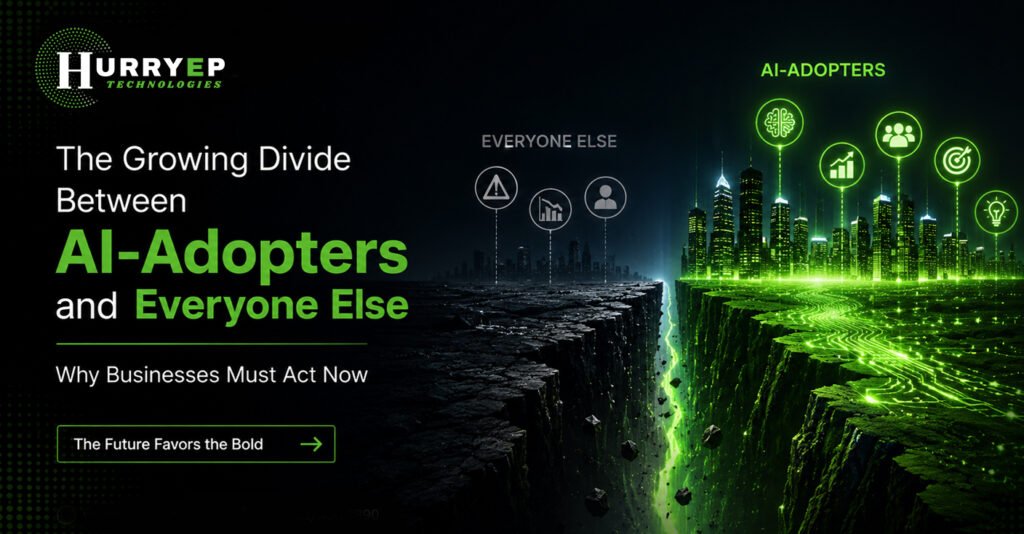
Yet, as AI adoption accelerates, a clear divide is beginning to emerge. On one side are organizations embracing AI to improve efficiency, unlock insights, and create new opportunities. On the other are businesses that remain hesitant, relying on traditional methods while competitors move forward.
This growing gap is not simply about technology adoption—it is about competitiveness, adaptability, and long-term sustainability. As AI becomes increasingly embedded in business ecosystems, the difference between adopters and non-adopters is becoming more visible.
Throughout history, technological innovation has changed the way businesses operate. The internet transformed communication, cloud computing redefined infrastructure, and mobile technology reshaped customer engagement. Today, artificial intelligence represents the next major shift.
Organizations are integrating AI into their operations because it offers the ability to process information faster, automate repetitive tasks, and generate insights that would otherwise require significant human effort.
Businesses across industries are using AI for:
The impact extends beyond operational efficiency. AI enables businesses to respond more quickly to changing market conditions, identify opportunities earlier, and make more informed decisions.
For companies seeking growth in increasingly competitive markets, AI is becoming a strategic necessity rather than an optional innovation.
As a result, organizations that embrace AI are establishing advantages that may become difficult for competitors to replicate later.
One of the most significant benefits of AI adoption is the ability to create competitive advantages before technologies become industry standards.
Early adopters are already experiencing measurable improvements across several areas.
AI automates repetitive and time-consuming tasks, allowing teams to focus on higher-value activities. Administrative processes, reporting, content generation, and data analysis can often be completed faster and more efficiently.
This increased productivity allows businesses to achieve more without proportionally increasing resources.
Modern consumers expect fast responses, personalized interactions, and seamless experiences. AI-powered systems help businesses deliver these expectations through chatbots, recommendation engines, predictive support, and personalized communication.
Improved customer experiences often translate into stronger engagement, loyalty, and retention.
Organizations generate enormous amounts of data, but extracting meaningful insights remains a challenge. AI helps businesses identify patterns, predict outcomes, and support strategic decision-making through advanced analytics.
Leaders can make decisions based on evidence rather than assumptions, reducing uncertainty and improving outcomes.
Businesses adopting AI are often able to test ideas, optimize campaigns, and respond to market changes more rapidly. This agility provides a significant advantage in dynamic and competitive industries.
The benefits of early adoption compound over time. As AI systems learn, improve, and integrate deeper into operations, organizations become increasingly efficient and adaptable.
While AI offers considerable opportunities, delaying adoption can create challenges that become increasingly difficult to overcome.
The most immediate risk is declining competitiveness.
As competitors improve productivity and customer experiences through AI, organizations relying solely on traditional methods may struggle to match performance levels. Processes that once seemed efficient can quickly become outdated.
Manual workflows often require more time, resources, and effort than AI-supported alternatives. Businesses that fail to modernize may face higher operational costs and slower execution.
AI is influencing how consumers discover information online. Search engines, recommendation systems, and AI-powered assistants increasingly prioritize relevant and authoritative content.
Businesses that fail to adapt their digital strategies risk becoming less visible to potential customers.
For example, companies seeking the best digital marketing company in Madurai increasingly evaluate agencies based on their ability to leverage emerging technologies, including AI-driven marketing solutions.
Modern professionals increasingly expect organizations to embrace technology that enhances productivity and supports innovation. Businesses that resist digital transformation may struggle to attract and retain skilled talent.
Perhaps the greatest risk is the opportunity cost of inaction. While competitors experiment, learn, and refine AI applications, non-adopters may miss valuable opportunities for growth, efficiency, and market expansion.
The longer organizations delay adoption, the more difficult it becomes to close the gap.
At Hurryep Technologies, we view artificial intelligence not as a replacement for human expertise but as a tool that enhances strategic thinking, creativity, and business performance.
The most successful organizations are not necessarily those implementing the most advanced AI systems. They are the ones applying AI thoughtfully to solve real business challenges.
Several practical applications are already delivering measurable results.
AI helps businesses analyze customer behavior, optimize advertising campaigns, generate content ideas, and improve audience targeting. This allows marketing teams to make faster and more informed decisions.
Businesses can use AI-assisted tools to support content research, planning, and optimization while maintaining human oversight to ensure quality and authenticity.
Administrative tasks, reporting processes, customer inquiries, and workflow management can be streamlined through automation, improving efficiency across departments.
AI-powered chat systems, recommendation engines, and personalization tools help businesses deliver more relevant and timely interactions.
Organizations that combine AI insights with human expertise are better positioned to identify trends, anticipate customer needs, and uncover new opportunities.
For businesses seeking the best SEO company in Madurai, the future of search visibility increasingly involves understanding how AI influences search behavior, content discovery, and user expectations.
The goal is not to adopt AI for the sake of innovation alone. The goal is to use AI strategically to create better outcomes for customers, employees, and the business itself.
Artificial intelligence is no longer a technology reserved for large enterprises or technology companies. It is becoming an essential component of modern business strategy.
As AI adoption accelerates, a growing divide is emerging between organizations that embrace innovation and those that remain hesitant. Early adopters are gaining advantages in productivity, customer experience, decision-making, and operational efficiency.
At the same time, businesses that delay digital transformation risk losing competitiveness, visibility, and growth opportunities.
The future will not belong exclusively to companies with the largest budgets or the most resources. It will belong to organizations that can adapt, learn, and leverage technology effectively.
In an AI-powered economy, success will increasingly depend on how quickly businesses transform information into action and innovation into value.